
Santa Clarita City Directory Shelf
Verified Santa Clarita directory evidence comes in discrete volumes, not a yearly run. The table separates telephone books, the 1969 local volume, yearbooks, and library databases. “Where held” names the custodian, not proof that every year survives.
| Collection | Years | Where Held | Access |
|---|---|---|---|
| Newhall telephone directory | March 1923 | SCVHistory digitized volume | Online; stable item title not located |
| SCV, Palmdale, Lancaster telephone directory | 1929 | SCVHistory digitized volume | Online; stable item title not located |
| Pacific Telephone directory for Newhall, Lake Hughes, Palmdale, Lancaster | January 1957 | SCVHistory; Pacific Telephone and Telegraph Co. | Online at the historical archive |
| Newhall, Santa Clarita Valley telephone directory | January 1958 | SCVHistory; Pacific Telephone and Telegraph Co. | Online at the historical archive |
| Newhall-Saugus-Valencia-Canyon Country Local City Directory | 1969 | SCVHistory; B&G Publications, Northridge | Online page and PDF; two chambers contributed |
| School yearbooks | Numerous school years | SCVHistory and local school collections | Digitized volumes online |
| The Signal archive | 1919-2015 | Santa Clarita Public Library | Searchable in library or on library Wi-Fi only |
| Los Angeles Times through ProQuest | 1985-current | Santa Clarita Public Library license | Library card and location rules apply |
| HeritageQuest | U.S. genealogy and local history sets | Santa Clarita Public Library license | Library authentication required |
| Newhall Sanborn map | 1892 | SCVHistory scan | Online historical map |
The 1923 and 1929 items are documented as discrete digitized volumes, but stable item titles were not located. The 1957, 1958, and 1969 links are more direct. The 1969 scan has a PDF companion. No verified source establishes a continuous Polk-style or reverse-directory run.
The digitized 1969 local directory gives the clearest view of the shelf's four-community coverage and compact entry style.
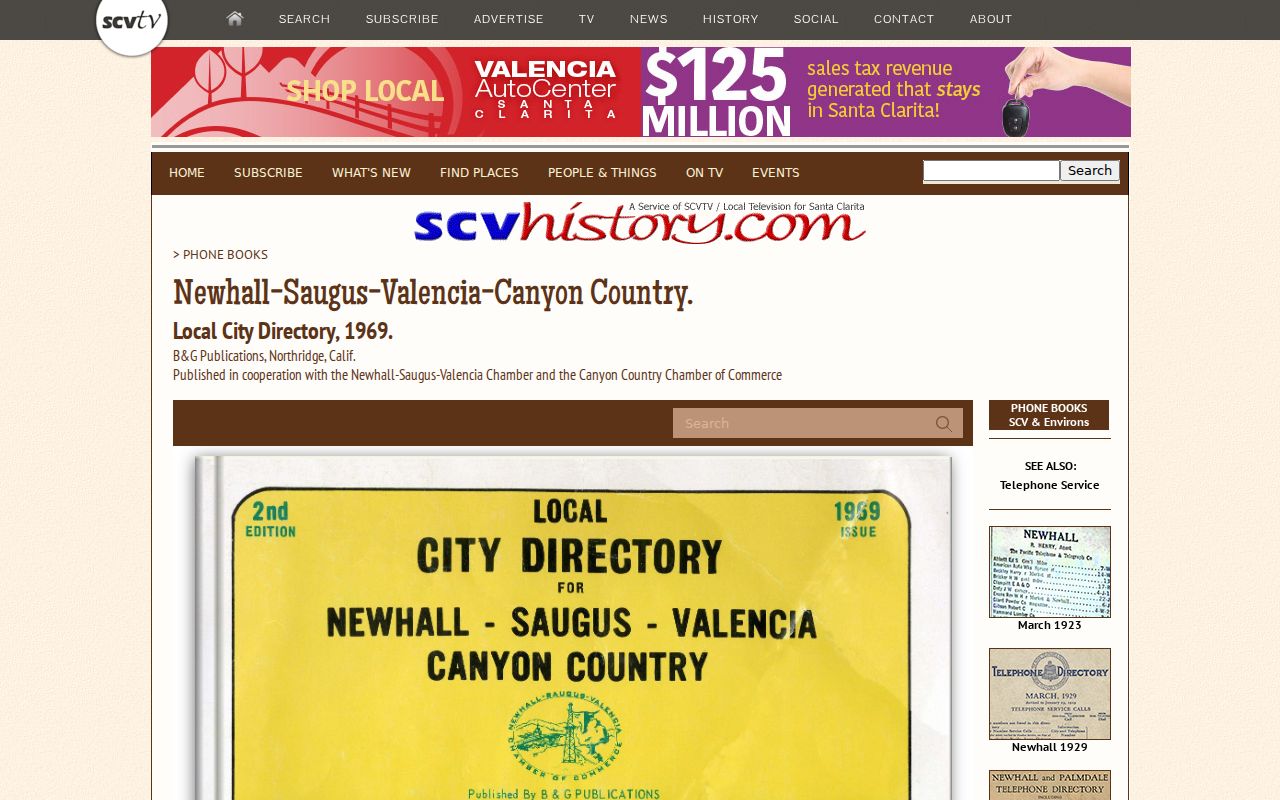
The scan is useful because it keeps the original community code, street wording, and phone format together instead of flattening them into a modern name list.
Before Santa Clarita, Four Community Names
A historical lookup changes with the place name. Santa Clarita incorporated on December 15, 1987, but the 1969 volume predates the legal city. Search Newhall, Saugus, Valencia, Canyon Country, and Los Angeles County. “Santa Clarita Valley” can cover more than the incorporated city.
| Era | Local record clue |
|---|---|
| 1876-1878 | Newhall began as a railroad town, then moved in 1878. |
| 1887 | Saugus dates from the later railroad and town-building era. |
| 1967 | Master-planned Valencia was dedicated, adding a newer place label. |
| Mid-1960s onward | Freeway and suburban growth produced newer subdivisions, permits, phone books, and newspapers. |
| December 15, 1987 | Four communities became part of the incorporated city; county record custody did not move to City Hall. |
Keep the name printed in the source before translating it into modern geography. A 1969 Newhall entry remains Newhall in notes, even when a later map places the address inside Santa Clarita. This prevents false gaps.
Note: Pre-1987 searches should retain Newhall, Saugus, Valencia, Canyon Country, and Los Angeles County as separate query terms.
Santa Clarita Directory Research Locations
Santa Clarita Public Library is the main counter and database stop. Canyon Country Jo Anne Darcy is at 18601 Soledad Canyon Road, Old Town Newhall at 24500 Main Street, and Valencia at 23743 W Valencia Boulevard. All share (661) 259-0750. Hours are Monday-Thursday 9-8, Friday 10-6, Saturday 10-5, and Sunday 1-5.
Search the catalog with “city directories,” “telephone directories,” “Newhall,” “Saugus,” “Valencia,” “Canyon Country,” and “Los Angeles County.” Ask reference staff to check noncirculating local-history and vertical files. A missing result is not proof that a volume is absent. Staff can explain whether a scan or paper file is used at a branch. Library databases require a card or in-building access.
The SCVHistory archive supplies the online path for local volumes, maps, yearbooks, government records, photographs, and oral history. The FamilySearch catalog can be searched by Los Angeles County and community name when a directory or record book is hard to identify. SCVHistory is a useful second search when a title lacks a catalog record.
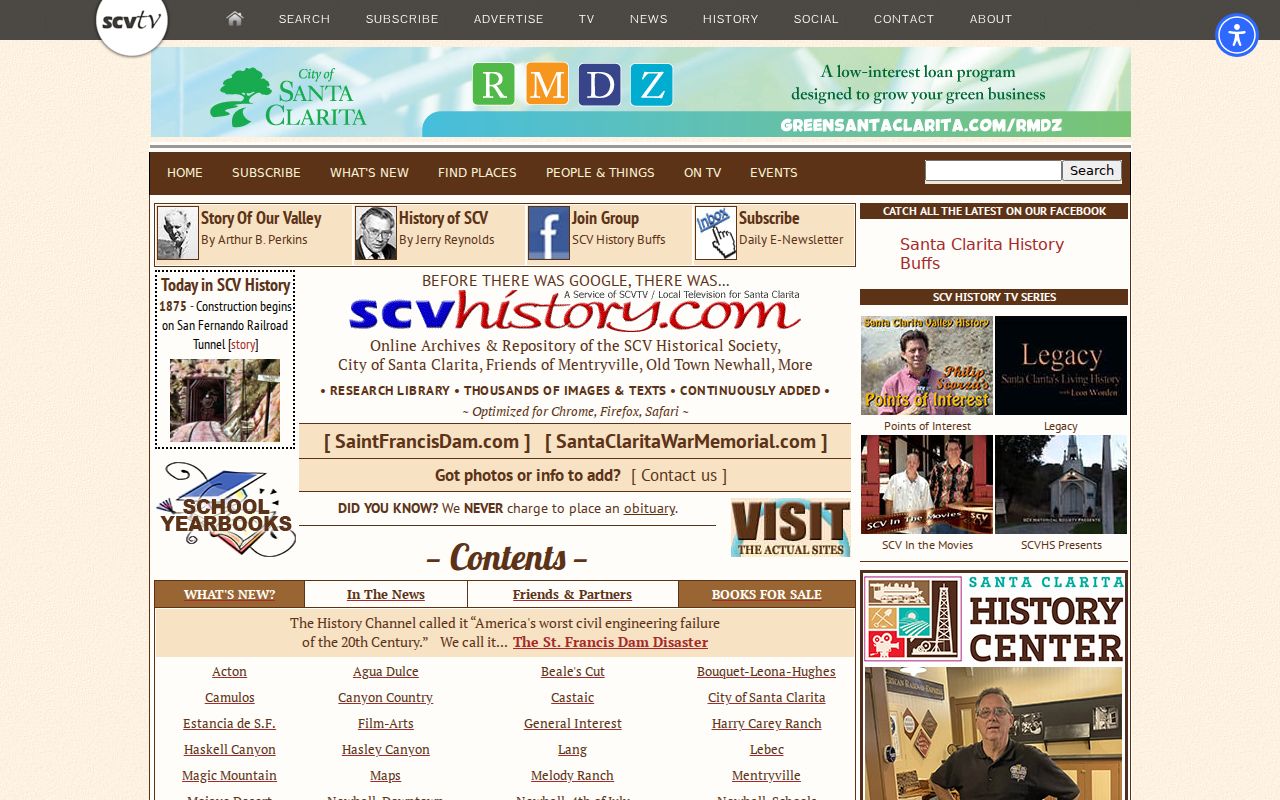
The archive landing page helps connect a directory name to related maps and community records, while the source page remains the authority for the scan itself.
Reading Santa Clarita City Directories
The 1969 local volume does not support every convention found in older national directories. Its inspected sample reads: “Newhall Jonathan Mang Editor Newhall Signal 22739 Eighth St, N … 259-3332.” It shows a name, title, affiliation, numbered street, one-letter community code, and phone. Preserve the printed order before expanding an abbreviation.
| Surname and first name | Newhall Jonathan, as printed. |
|---|---|
| Occupation or title | “Mang Editor,” not expanded. |
| Business or affiliation | Newhall Signal, the named organization. |
| Street line | 22739 Eighth St; community code “N.” |
| Phone | 259-3332, in printed format. |
Business pages may name a proprietor. Organization pages may list officers, titles, meeting details, addresses, and phones. These are civic clues, not proof of residence. Do not add spouse, widow, or owner-renter marks unless a printed key supports them.
- Criss-cross directory
- An address-order component that can lead from a known building or street to a name. Check the local volume first.
- Householder index
- A name-based finding aid for people or heads of households. It is a label, not a promise that every resident appears.
- Abbreviation key
- The printed legend for shortened occupations, groups, communities, or address marks. Read it before “Mang” or the community code.
Santa Clarita's Telephone Directory Timeline
Early telephone coverage was small. Local history records one Newhall telephone in 1900, two in 1911, 18 in 1917, 57 in 1925, 74 in 1926, and 100 by March 1927. The sequence appears in the March 1927 local telephone history. An early blank can reflect limited service, not an empty home.
The March 1923 and 1929 items are narrow snapshots. The January 1957 Pacific Telephone volume covers Newhall, Lake Hughes, Palmdale, and Lancaster from 24275 N. Walnut Street. The January 1958 volume follows for Newhall and the Santa Clarita Valley. Compare them as neighboring artifacts, not as a complete household census.
Note: Early telephone counts describe service scale, not a count of households or a complete list of residents.
Santa Clarita Directory Companions
Yearbooks add faces, class years, school names, and family spellings that a phone book may omit. The SCVHistory school yearbook collection includes local schools, Hart, and College of the Canyons. Current student records remain private.
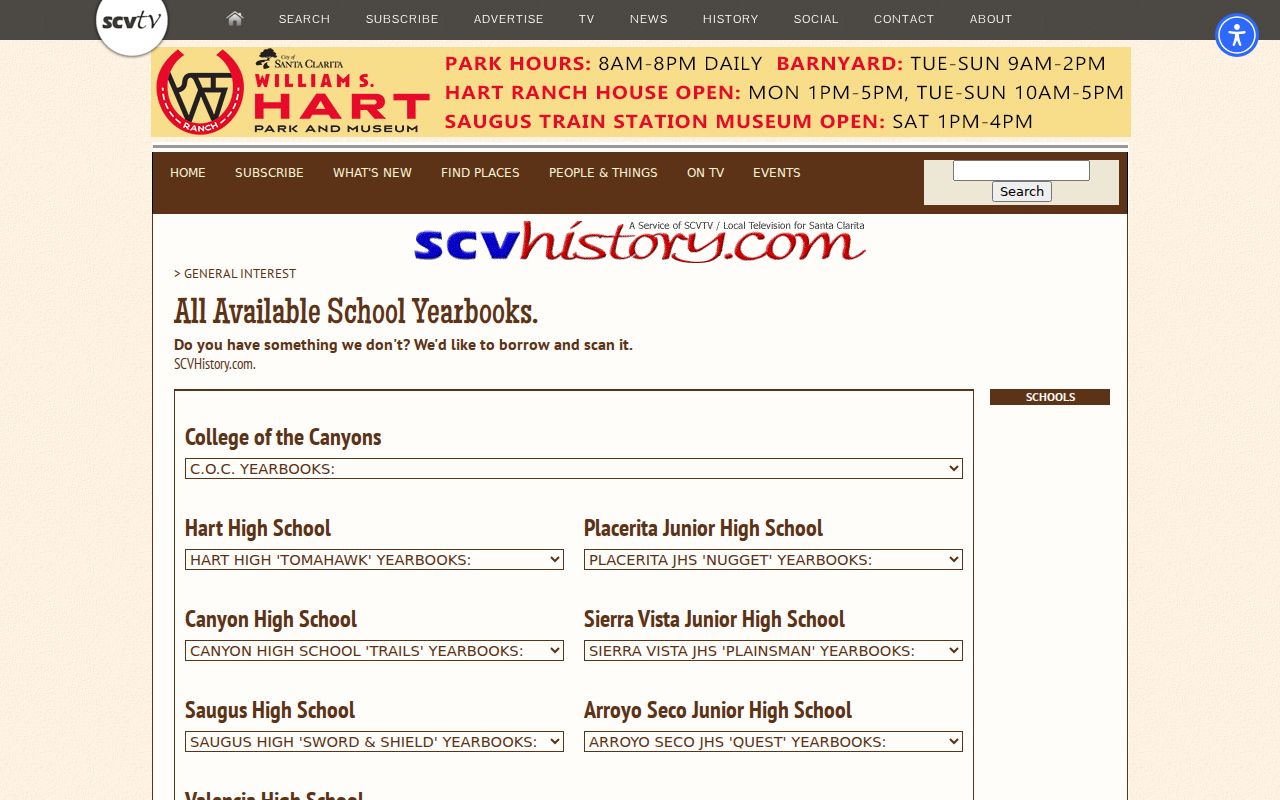
A yearbook scan can place a surname in a school community for one year, then point toward a newspaper or family record without claiming more than the page shows.
The Signal archive runs from 1919 through 2015 and contains more than 520,000 searchable pages, with library or library-Wi-Fi access. Search notices, stories, names, and place terms there. Los Angeles Times ProQuest reaches 1985-current under library card and location rules. HeritageQuest adds U.S. genealogy sets through library authentication. No authoritative obituary index or continuous reverse-directory shelf inventory was located.
Trace a Santa Clarita Household
Pair each city directory year with the closest census year and write down every change. Begin with the surname or business section, not a modern city label. The 1950 federal census is the newest public census under the 72-year rule; later gaps need newspapers, permits, deeds, and other open sources.
- Choose a community and year. Search Newhall, Saugus, Valencia, or Canyon Country as printed, then record the exact name.
- Transcribe title, business, numbered street, one-letter code, and phone. Do not normalize the address yet.
- Inspect nearby alphabetic entries and any street or reverse component for spelling variants or another household.
- Compare the next volume and search The Signal for the name, street, or organization. Mark a move or missing entry as a fact, not a conclusion.
- Pair the result with the 1950 census. Compare names, ages, household members, and address wording, remembering that the records differ.
- After 1950, follow the address through permits and county deeds. An applicant or deed party may not be an occupant. The Santa Clarita Street Directory handles modern address work.
If a name disappears, test a move, death, spelling shift, unlisted number, or volume gap. An obituary, newspaper notice, or yearbook may explain the change. Keep a source date beside each inference.
Old Santa Clarita Addresses on Maps
Maps keep a historic street line from being mistaken for a modern mailing address. The SCVHistory maps and aerial catalog includes the 1870 partition map, 1874 plat, 1875 Lyon’s Station, Southern Pacific transactions from 1876-1992, the 1889 Newhall plat, the 1892 Sanborn, and later subdivision maps.
The 1892 Newhall Sanborn map names some owners and functions and records construction, fire, and water features. It bridges Fir to Walnut, Maple to Chestnut, and Spruce to San Fernando Road to Main Street. The depot is at Railroad and Market; the school is at Fir and 9th.
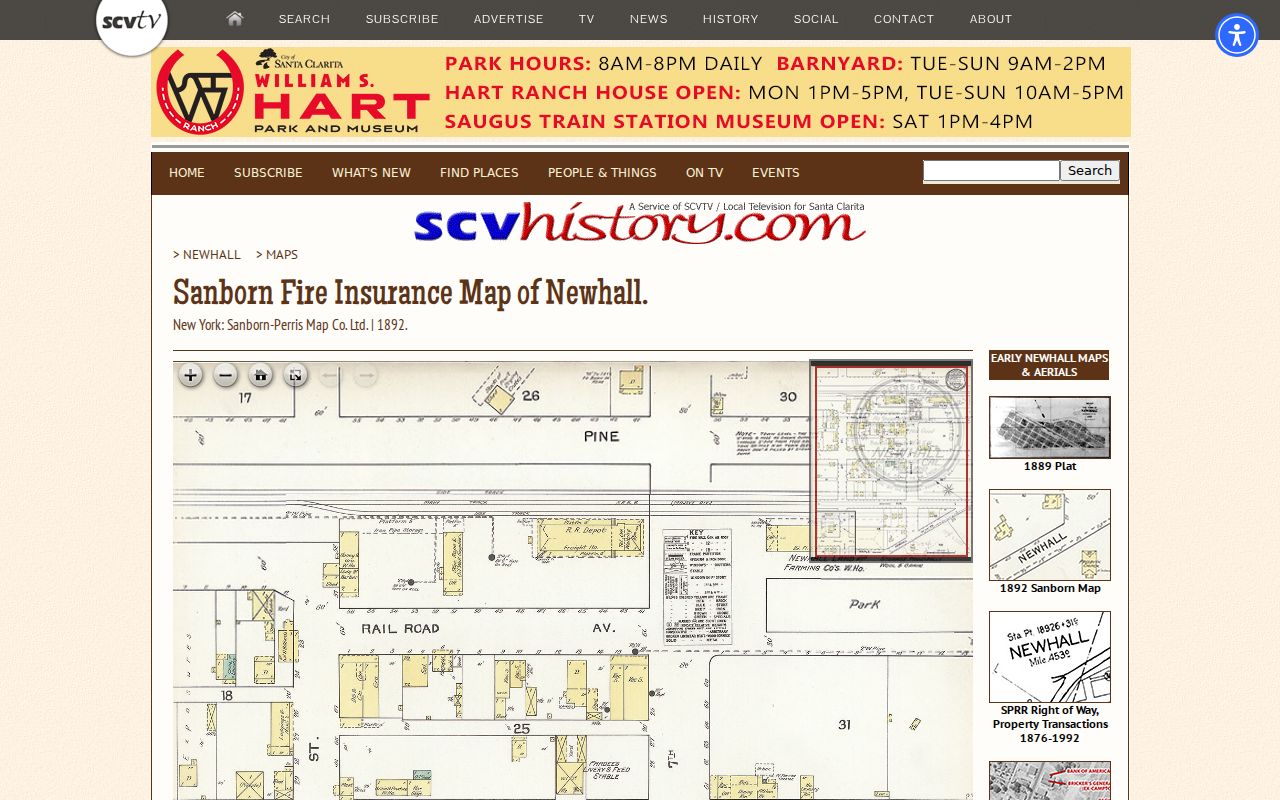
The map supplies block and building context for a directory address. It should not be treated as a modern USPS address or as proof that a named person occupied the building.
No authoritative Santa Clarita-wide street-renumbering year was located. Compare the block, building, owner, or function across maps, directories, recorded instruments, assessor map books, and USPS records instead of inventing a date.
Note: A historic map can bridge street names, but it cannot certify a modern address or current occupancy.
Santa Clarita Records Beyond Directory Years
City-held material can fill a city directory gap. Search the Santa Clarita Laserfiche repository and Council packets first. If an existing file is not published, use the City Clerk public-records channel with a date range, department, project or address, permit or case number when known, and the desired format. A request need not explain its purpose, but it cannot require a new resident list or answers. Redactions and exemptions may limit the result.
For a post-1950 property trail, Los Angeles County access is different. The county has no complete public online recorded-real-estate index. In-person review at 12400 Imperial Highway in Norwalk is by appointment, with 1851-1957 indexes downstairs and 1958-present upstairs. The alphabetical index uses name and recording year, not street or phone. Start at the county real-estate records page.
Phone help is (800) 201-8999, property recording option 2 or recorded records option 3. Mail requests need the document title, names, and search year, and go to RR/CC Real Estate Records, PO Box 1130, Norwalk, CA 90651-1130, with a check or money order. The county states 20 working days and does not take telephone requests for the mail search. Use the mail instructions.
What Santa Clarita Directories Prove
A directory entry proves that a publisher recorded a name, place, service, or organization in one volume. It does not prove current residence, ownership, family relationship, or continuous presence. The SCV Chamber directory offers Quick Search, All/People/Company, A-Z/Recent, and advanced Looking For, Keyword, and Business Category filters. Its People results are chamber contacts, not a resident roll.
Source discipline. Keep the image, printed community code, access date, and transcription together. Check each directory clue against an independent census, map, newspaper, deed, or permit.
The late city name matters. Municipal administrative records begin with incorporation, while county custody of deeds, courts, elections, and vital records continues across the older communities. A family search may move from SCVHistory to the library, then to a county counter or written request. That split keeps the historical city directory’s limits clear.